Potting soil calculator
How many liters of potting soil will these pots or planters take? Measure the inside, say how many you’re filling, and add a bag size to see how many bags to buy.
How it’s worked out
Every measurement is in centimeters, and 1000 cm³ make one liter.
Round pot: π × (diameter ÷ 2)² × fill height ÷ 1000.
Rectangular planter: length × width × fill height ÷ 1000.
The total is the liters for one container times the number of containers. With a bag size, the total is divided by it and rounded up to whole bags; the leftover is what you buy minus what you need.
Liters are shown to one decimal, but the bags are worked out from the unrounded volume. No margin is added for settling, and nothing is taken off for a root ball.
Worked example
Two rectangular planters, 40 cm long and 20 cm wide inside, filled to 18 cm, with 20 L bags.
40 × 20 × 18 ÷ 1000 = 14.4 L for each planter, so 28.8 L in total. 28.8 ÷ 20 = 1.44, which rounds up to 2 bags: 40 L bought, 11.2 L left over.
Questions
Should I measure the inside or the outside of the pot?
The inside. Pot walls take up room, so outside measurements overstate the soil. For the height, measure from the inside bottom up to where the soil will reach, which is usually a little below the rim.
Does the calculator add extra for settling?
No. It gives the volume of the space you fill. Potting soil settles after the first few waterings, and some bags are sold compressed, so you may want a little more. The calculator leaves that margin to you.
Can I use it for a square container or a raised bed?
Yes, as long as the sides are straight. Choose Rectangular planter and enter the inside length and width; for a square container, they’re the same.
What about a pot that narrows towards the base?
This version assumes straight sides. For a tapered pot, measure the diameter halfway down the part you’ll fill: the estimate will be close, if slightly low.
More calculators
Soil mix calculator
Turn your recipe’s percentages into liters of each component.
Fertilizer dilution calculator
Scale the dose on your fertilizer’s label to the water you’re mixing.
Mulch calculator
Mulch volume for one or more beds, in cubic yards or liters, and the bags to buy.
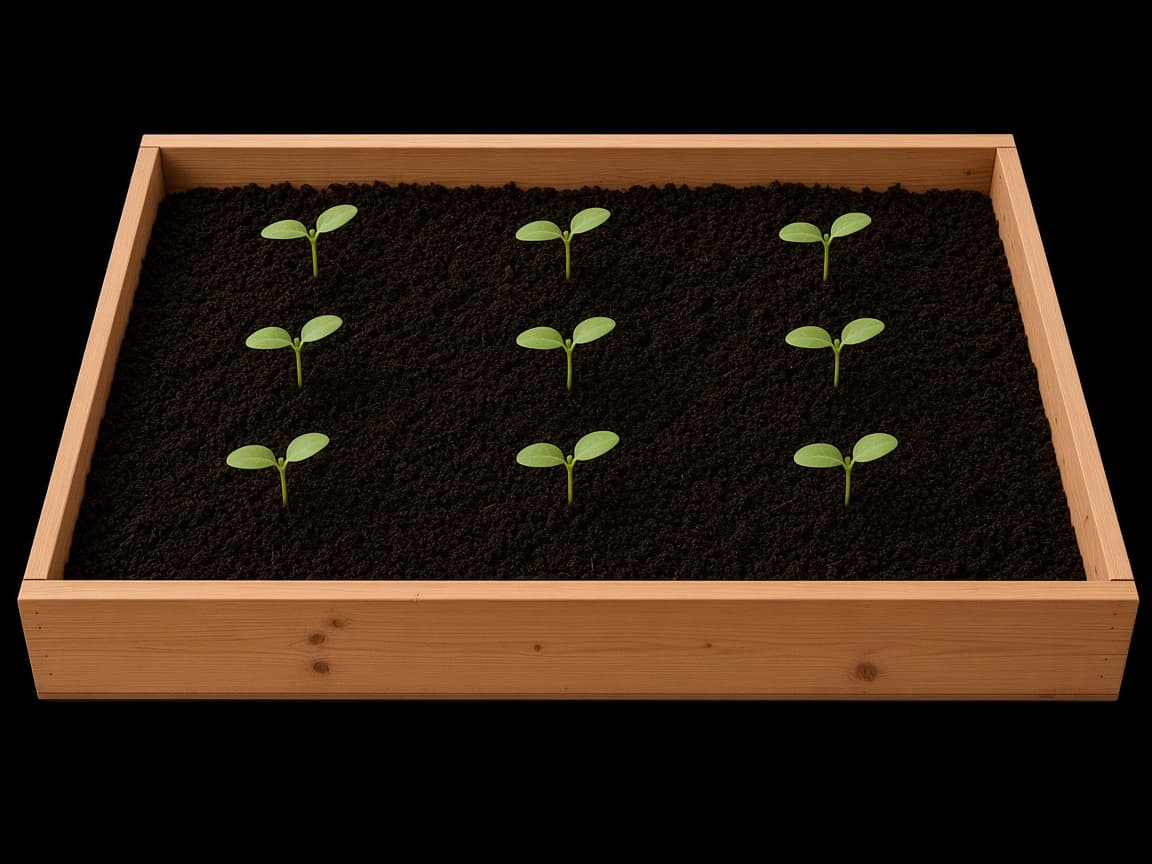
Plant spacing calculator
How many plants fit in a rectangular bed at your spacing, with a drawing of the grid.
Grass seed calculator
Pounds or kilograms of grass seed for your lawn at the label’s rate, and the bags to buy.