How to Measure Plant Pots: Diameter, Depth, and Fit
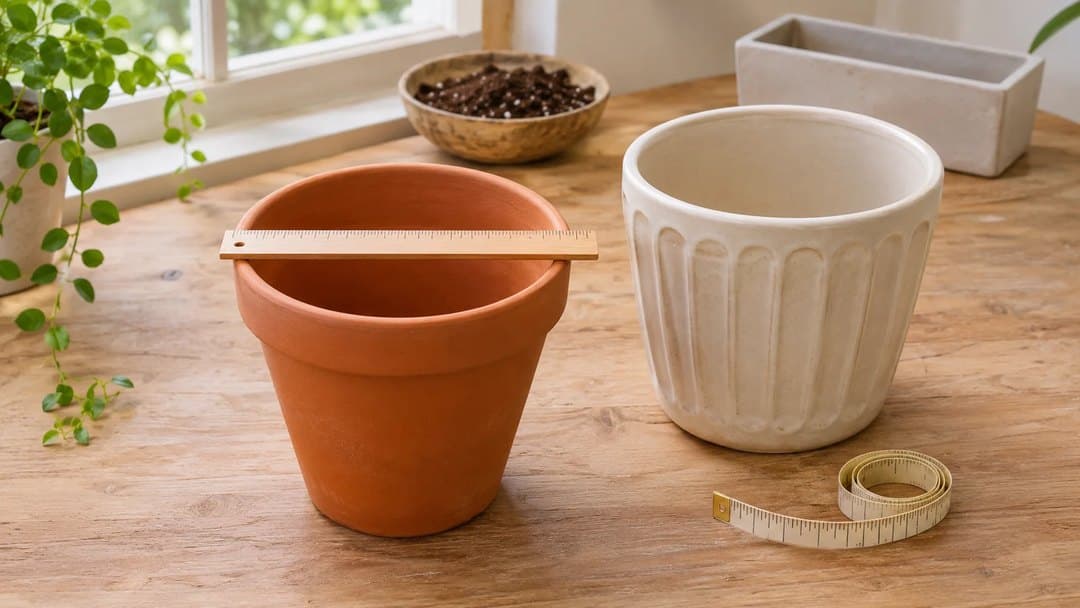
To measure a plant pot, start by deciding what you need the measurement for. Checking whether a nursery pot fits inside a decorative container requires different measurements than choosing a saucer or estimating the space available for potting mix.
For a round pot, measure straight across the center to find its diameter. Then check its depth and whether its sides narrow toward the bottom. Record whether each measurement describes the inside or outside of the container.
A ruler or tape measure is all you need. Here’s where to place it and how to interpret the numbers.
Which pot measurements do you need?
Before reaching for your tape measure, identify the question you’re trying to answer.
| Your goal | What to measure |
|---|---|
| Fit a nursery pot inside a decorative pot | The nursery pot’s outside dimensions and the decorative pot’s usable inside dimensions |
| Find a saucer | The pot’s outside base dimensions and the saucer’s usable inside dimensions |
| Measure a round container for potting mix | Inside diameter and intended fill height, noting any taper |
| Measure a rectangular planter for potting mix | Inside length, inside width, and intended fill height |
| Compare pots while shopping | The dimensions the seller provides, including whether they are interior or exterior measurements |
Write down the purpose alongside the numbers. “Inside diameter: 8 inches” is more useful than “8-inch pot.”
How to measure the diameter of a round pot
Diameter is the straight-line distance across a circle through its center. It is different from circumference, which is the distance around the outside.
Place your ruler or tape measure across the opening, passing through the center. Keep it straight rather than following the curve of the rim.
Take two measurements when they are relevant:
- Outside diameter: from one outer edge to the opposite outer edge.
- Inside diameter: from one inner wall to the opposite inner wall.
Thick walls and wide rims can make these measurements noticeably different.
If the pot is slightly oval or irregular, measure in more than one direction. For fitting another container inside, the narrower usable dimension may be the limiting one.
What does an “8-inch pot” mean?
An inch-based pot size often describes a diameter, but the label alone may not tell you exactly where it was measured.
It may describe an outside opening, an inside opening, or a nominal product size. Check the manufacturer’s dimensions rather than assuming two pots with the same label will fit together.
The label also does not tell you the pot’s depth. Two containers with similar openings can have very different shapes.
Measure depth separately from fill height
For usable inside depth, measure vertically from the interior bottom to the top opening. Don’t run the tape along a sloping wall: that gives you the length of the wall rather than the vertical depth.
Look inside before measuring. A raised bottom, built-in insert, or reservoir can reduce the space available for another pot or for potting mix.
If you are preparing a container for direct planting, also identify the intended soil line.
Fill height runs from the interior bottom of the planting space to that line. It is shorter than the full inside depth when you leave space below the rim for watering.
The University of Maryland Extension recommends leaving headroom for watering when repotting indoor plants. The appropriate planting position should also account for the root ball. See its potting and repotting guidance.
Measure the container for your planting plan; don’t bury a plant more deeply simply to fill the pot.
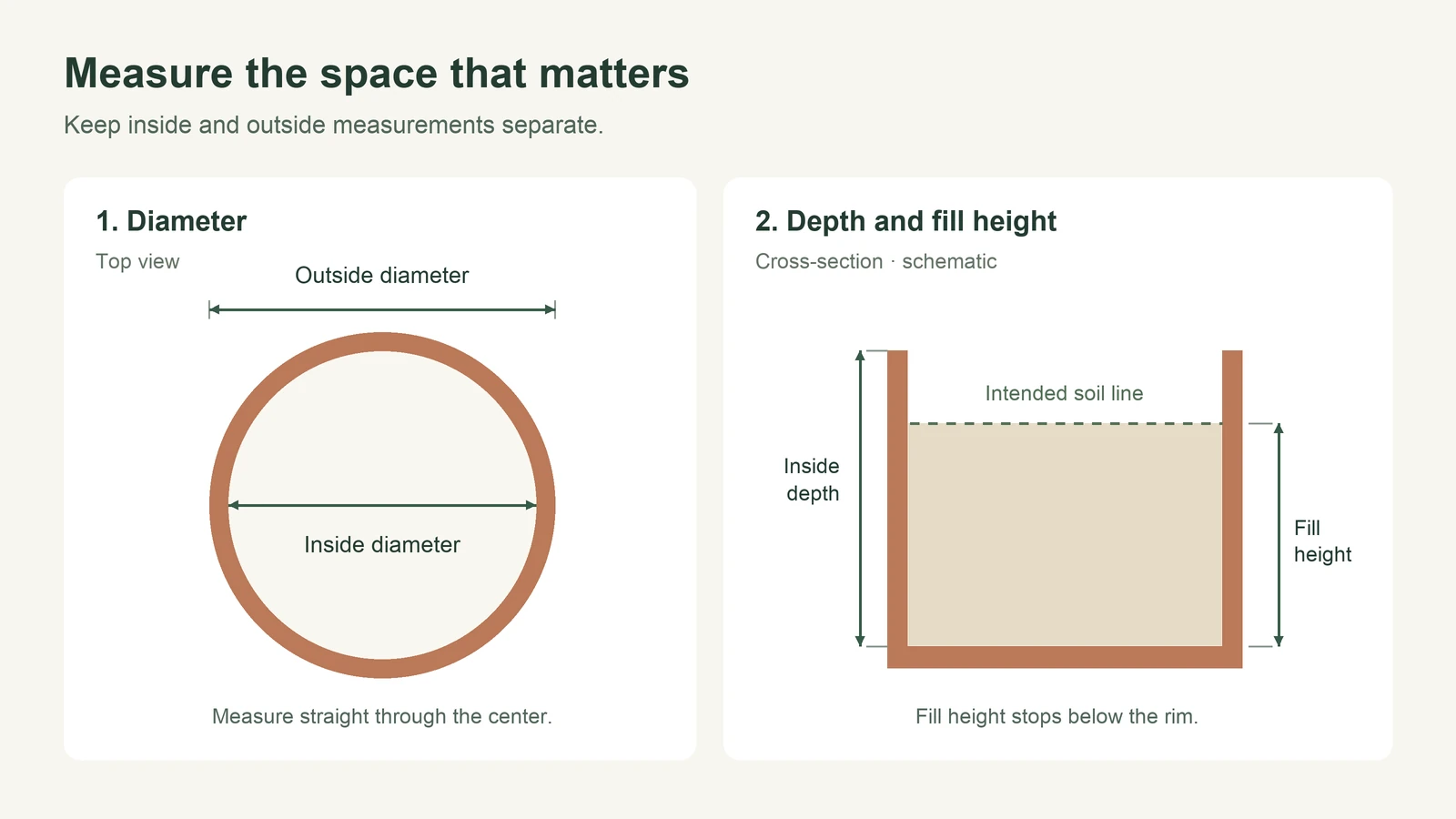
Record inside and outside diameter separately. For potting mix, measure fill height to the intended soil line rather than automatically to the rim.
How to check whether a nursery pot fits a decorative pot
When you keep a plant in its nursery pot and place that inside a decorative container, you are comparing the outside of one pot with the inside of another.
Start with the nursery pot:
- Measure its widest outside diameter, including any projecting rim.
- Measure its outside height.
- Note any handles, feet, or protrusions that could interfere with the fit.
Next, measure the decorative container:
- Check the inside opening.
- Check whether the interior narrows farther down.
- Measure the usable inside depth, accounting for any raised base or insert.
A nursery pot may pass through the opening but stop before reaching the bottom. This is especially easy to miss with tapered decorative pots.
For example, a nursery pot that measures 6.5 inches across its widest point will not fit through a decorative pot’s 6-inch inside opening, even if both products are sold under a similar size description.
Leave enough room to insert and remove the nursery pot comfortably. Don’t force it into a tight fit.
Physical fit is only one check. You also need a practical way to drain the nursery pot and remove water collected in the outer container.
How to measure a square or rectangular planter
Measure the interior length and width between the walls, then measure the vertical inside depth.
If you are measuring for potting mix, use the intended fill height rather than automatically measuring to the rim.
Keep your notes clear:
- Inside length.
- Inside width.
- Intended fill height.
- Any taper, internal ledge, or raised base.
If the planter narrows toward the bottom, measure the lower dimensions too. The opening may be much larger than the space below it.
For a nursery pot that will sit inside a rectangular planter, compare the pot’s outside dimensions with the planter’s usable interior space at the height where it will sit.
Pay attention to tapered and curved pots
Many pots are wider at the top than at the base. Others have rounded sides, narrow necks, or internal shelves.
For these containers, one measurement across the opening cannot describe the whole interior.
Record the inside opening, lower width, and usable depth. If you are checking a fit, look for the narrowest section the nursery pot must pass through or occupy.
If you are estimating capacity, remember that a tapered pot does not hold the same amount as a straight-sided cylinder with the same top diameter and height.
Avoid treating a simple volume estimate as an exact description of a curved or irregular container.
Measuring a pot for a saucer
A saucer needs to accommodate the part of the pot that rests inside it.
Measure the outside diameter or width of the pot’s base, including any feet or protrusions. Then compare that with the saucer’s usable inside base, rather than only its outer rim.
A saucer with sloping sides may have a wide opening but a much smaller flat area at the bottom.
Check that the pot sits securely and that collected water can be emptied easily.
When to use Hortola’s potting soil calculator
Once you have measured the space intended for potting mix, the Hortola potting soil calculator can help estimate its volume.
For a round pot, you’ll need the inside diameter and fill height. For a rectangular planter, you’ll need the inside length, width, and fill height.
The calculator currently uses centimeters for dimensions and liters for volume. If you measured in inches, convert each measurement first: one inch equals 2.54 centimeters.
Keep its scope in mind:
- The round-pot calculation assumes a straight-sided cylinder.
- The result does not automatically subtract an existing root ball.
- No extra allowance is added for settling.
Use the calculator after measuring to estimate quantity. It does not determine whether a particular pot is suitable for your plant.
Common measuring mistakes to avoid
Comparing two outside measurements. For a pot-in-pot arrangement, compare the nursery pot’s exterior with the decorative container’s interior.
Measuring around the rim. That gives circumference, not diameter.
Ignoring the bottom. Tapered walls and raised bases can prevent a container from fitting.
Confusing full depth with fill height. Record both if you need them for different decisions.
Relying on the size label alone. Check the seller’s measurement convention and verify the actual dimensions when fit matters.
Keep a useful record of your measurements
Before shopping, make a short note with the measurements that matter for your project. A photo showing where you placed the tape can help you remember what each number describes.
If you later repot the plant, you can record the change and follow its care in your Hortola garden.
Start with the right measurements for the question you’re answering. Then use those measurements to check the fit, compare containers, or move on to estimating potting mix.